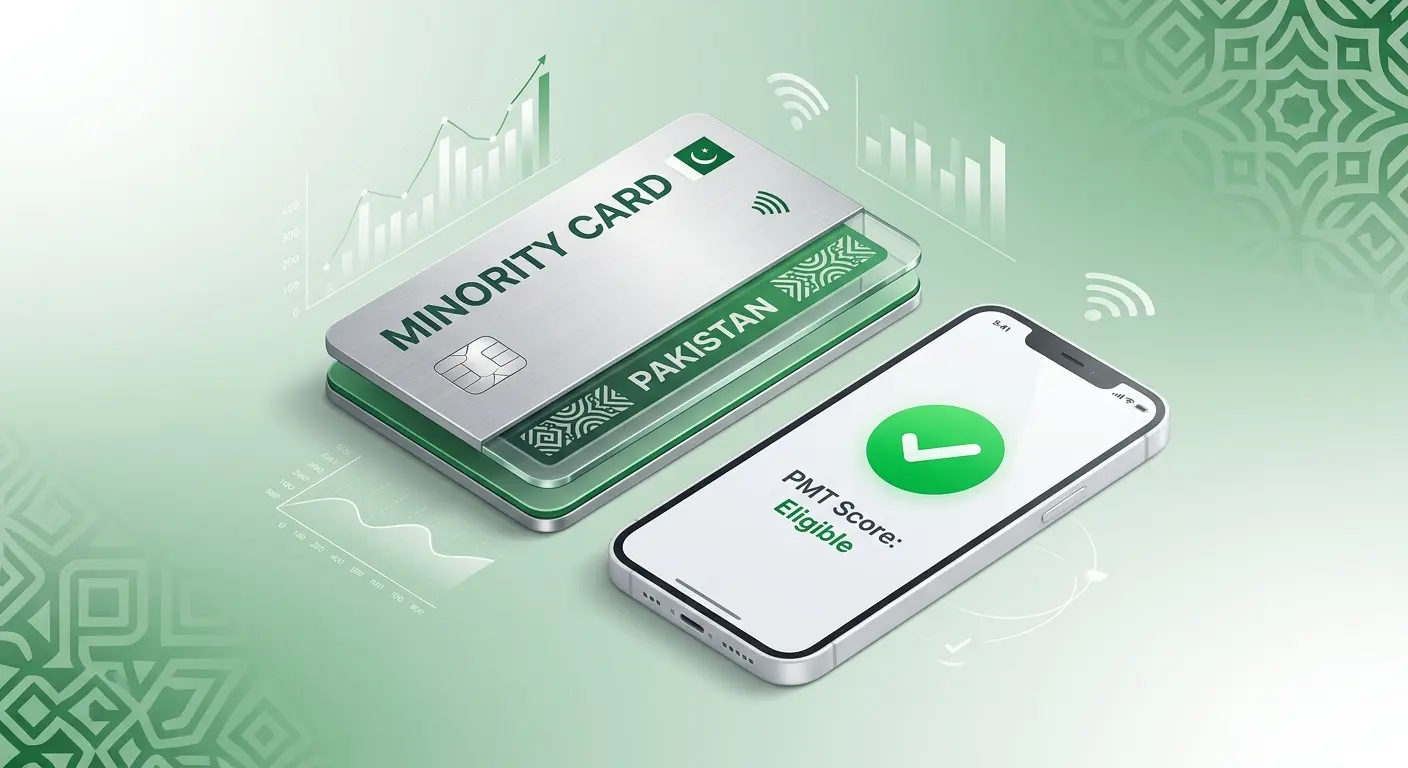
PMT Score Check for Minority Card is an important step for individuals who want to verify their eligibility for government assistance programs in Pakistan.
Minority Card PMT Score Checker
Estimate your household eligibility for the Minority Card welfare support programme
Household details
Monthly income & expenses
Assets & utilities
Analysing household data…
Score breakdown
Recommendations for you
Based on Pakistan’s PMT (Proxy Means Test) methodology used to assess Minority Card welfare support eligibility. This is not an official government tool and no CNIC or personal data is stored or transmitted. For your official status, check with the National Commission for Minorities or your local social welfare office.
This process helps applicants understand whether they qualify for a Minority Card based on their household PMT score, which is calculated using socio-economic data.
By using the PMT Score Check for Minority Card online methods, users can quickly confirm their status without visiting any office, making the entire process simple, transparent, and accessible for everyone.
This guide provides an exhaustive, step-by-step breakdown of how to verify your PMT score online, understand the eligibility thresholds, and ensure your household is correctly represented in the government database.
Why the PMT Score Check for Minority Card is Your First Priority
Think of the PMT Score Check for Minority Card as the “digital gateway” to your benefits. In 2026, the government relies strictly on data to decide who gets support, meaning you can’t afford to be in the dark about your status.
Verifying your score early ensures you aren’t left waiting for aid that might be blocked by outdated NSER information or simple clerical errors.
It is the fastest way to confirm your eligibility status before you even set foot in a registration office, saving you time and protecting you from unofficial agents who might try to mislead you about your qualification.
Understanding the PMT Score: The Mechanics of Poverty Mapping
The Proxy Means Test (PMT) is not a simple calculation of your monthly salary. Instead, it is a complex algorithmic assessment that “proxies” or estimates a household’s welfare level based on observable characteristics.
Because many people in the informal economy do not have verifiable pay stubs, the government uses this method to ensure aid reaches the truly deserving.
How the PMT Score is Calculated
The government assigns a value between 0 and 100. A lower score indicates a higher level of economic vulnerability, while a higher score suggests financial stability. The 2026 calculation model looks at several key pillars:
- Dependency Ratio: The number of children, elderly, or disabled family members relative to the number of earning adults.
- Asset Ownership: This includes “movable” assets (motorcycles, tractors, cars) and “immovable” assets (agricultural land, commercial property, or residential plot size).
- Utility Consumption: Your average electricity and gas bills over the last 12 months are used as a proxy for lifestyle expenditure.
- Housing Quality: The registry tracks whether your home is Katcha (mud/temporary) or Pakka (brick/permanent), and the number of rooms per inhabitant.
- Educational Attainment: The literacy level of the head of the household and the school enrollment status of the children.
What is the Minority Card in Pakistan?
The Minority Card is a specialized identification and welfare card issued to non-Muslim Pakistanis (including Christian, Hindu, Sikh, Parsi, and Kalash communities).
While the CNIC identifies you as a citizen, the Minority Card identifies you as a beneficiary of specific provincial and federal protection programs.
Key Benefits of the Minority Card in 2026
- Monthly Stipends: Regular cash transfers through the BISP or provincial umbrellas like the “Himmat Card” or “Khidmat Card.”
- Marriage Grants: Financial support for the marriage of daughters from low-income minority families.
- Educational Scholarships: Dedicated quotas and funding for minority students in schools, colleges, and universities.
- Health Coverage: Integration with Sehat Sahulat programs, providing free indoor hospital treatment.
- Emergency Relief: Priority access to government aid during natural disasters or economic shocks.
PMT Score Eligibility Thresholds for 2026
Eligibility is not “one size fits all.” Different programs have different “cut-off” scores. To qualify for the Minority Card and its associated cash benefits, you generally need to fall within the following ranges:
| Eligibility Status | PMT Score Range | Categorized as the “poorest of the poor”, eligible for all benefits. |
| Highly Eligible | 0 – 16.1 | Categorized as the “poorest of the poor”; eligible for all benefits. |
| Eligible | 16.2 – 32.0 | Standard eligibility for BISP and Minority Card monthly stipends. |
| Conditional | 32.1 – 40.0 | Eligible for specific subsidies (e.g., cheap flour/fuel) but not monthly cash. |
| Ineligible | 40.1 and Above | Considered financially self-sufficient; application usually rejected. |
Note: These thresholds are subject to change based on the annual budget and provincial policy updates in Sindh, Punjab, KPK, and Balochistan.
How to Check PMT Score Online: 4 Official Methods
Checking your status no longer requires standing in long queues at tehsil offices. You can verify your data using these official channels.
Method 1: The 8171 Web Portal (Primary Method)
The 8171 portal remains the most reliable way to check both BISP and Minority Card eligibility.
- Open your web browser and search for the 8171 Check Online portal.
- On the homepage, you will see a field for CNIC Number.
- Enter your 13-digit CNIC without any dashes (e.g., 4210112345671).
- Enter the Verification Code (Captcha) displayed in the image.
- Click on the “Check Eligibility” button.
- The system will display your PMT score and whether you are “Eligible” for current installments.
Method 2: SMS Verification via 8171
If you are in an area with poor internet connectivity, the SMS service is the fastest alternative.
- Open the Messaging app on your phone.
- Create a new message and type your 13-digit CNIC number.
- Send this message to 8171.
- You will receive a reply within minutes. This reply will state if your household is registered and provide your eligibility status. While it may not always list the exact PMT decimal, it will tell you if you fall below the required threshold.
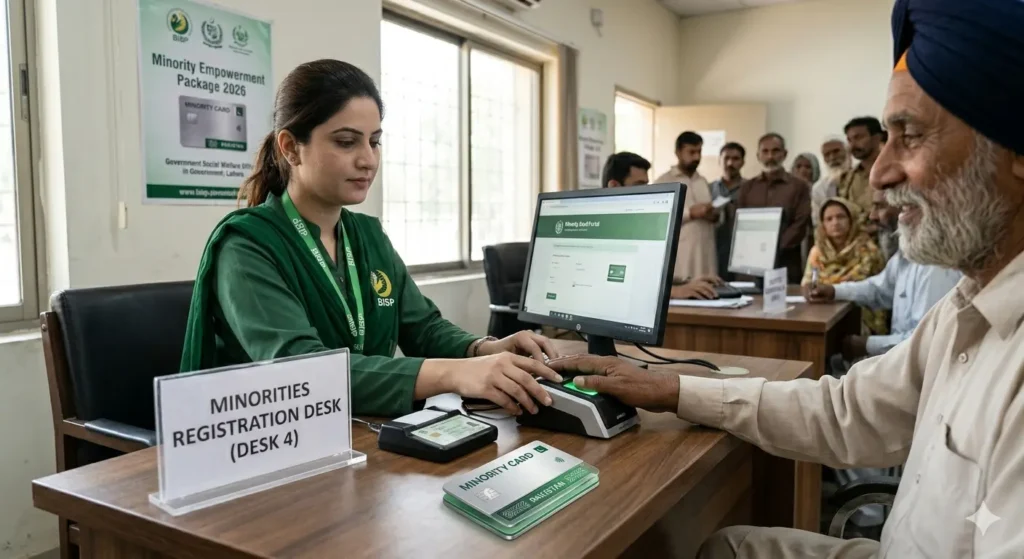
Method 3: BISP Tehsil Registration Centers (NSER Desks)
If the online portal shows “No Record Found,” it means your household has not been surveyed recently.
- Locate your nearest BISP Tehsil Office.
- Visit the NSER Survey Desk with your original CNIC and the CNICs of all family members.
- Provide accurate information regarding your assets and income.
- Once the survey is completed, a new PMT score will be generated within 3 to 6 months.
Method 4: Provincial Minority Affairs Portals
Some provinces, such as Punjab and Sindh, have established their own portals for the “Minority Empowerment Package.”
- Visit the official website of your provincial Minority Affairs Department.
- Navigate to the “Welfare Schemes” or “Minority Card” section.
- Enter your CNIC to see if your provincial PMT status matches the federal database.
Why is My PMT Score So High?
It can be frustrating to find your score is above 40 when you are struggling financially. Several factors can artificially inflate your PMT score:
- Outdated Data: If you owned a motorcycle five years ago but sold it, but the NSER record still shows it as owned, your score will stay high.
- Utility Bill Spikes: A one-time spike in electricity usage (perhaps due to a technical fault or a temporary visitor) can mislead the algorithm.
- Bank Transactions: Frequent large transactions in your bank account—even if they are for someone else—can trigger a high-income flag.
- Government Employment: If any family member is a government employee, the household is often automatically disqualified or assigned a high score.
How to Appeal or Update Your PMT Score
If your score is incorrect, you have the legal right to a “Dynamic Registry” update.
Step 1: Gather Documentation
Collect your latest electricity bills, death certificates of deceased earning members, and proof of current (lower) income.
Step 2: Visit the BISP Digital Hub
Go to a designated Digital Hub in your district. Explain that your socio-economic conditions have changed since the last survey.
Step 3: Re-Survey
The officer will update your household profile. Be honest about your dependents; a higher number of children or elderly members will naturally lower your PMT score.
Frequently Asked Questions (FAQs)
Does the Minority Card expire?
The card itself typically follows the validity of your CNIC, but your eligibility is re-evaluated every 2-3 years through the NSER survey cycle.
Is there a fee for checking the PMT score?
No. All official government methods (8171 SMS, web portal, and office visits) are 100% free of charge. Beware of agents asking for “processing fees.”
Can I have a Minority Card and a BISP Kafalat Card at the same time?
Generally, yes. The Minority Card often acts as an additional layer of support, providing specific grants (like the Holi or Christmas gift fund) that are separate from the standard BISP stipends.
What if my CNIC is from one province but I live in another?
Your PMT score is tied to your household’s physical location during the NSER survey. You should update your address at NADRA and then re-register with the BISP office in your current city.
Conclusion
The PMT Score Check is the most critical step for any minority citizen looking to access government support in 2026. By understanding that this score is a reflection of your household’s total economic environment—not just your salary—you can better navigate the registration process.
Always ensure your information in the National Socio-Economic Registry is up to date. If your score is currently too high, use the dynamic registry desks to reflect your true financial situation.
With a score below 32, the doors to financial aid, educational support, and healthcare through the Minority Card will remain open to you and your family.

I am Shan ALI, a Pakistani digital content creator with a strong interest in public welfare, government programs, and making official information accessible to ordinary citizens.
My PMT score plz update