As Pakistan moves toward a more localized and data-driven approach to social welfare, the Punjab Socio-Economic Registry (PSER) has emerged as the definitive database for provincial assistance.
PSER PMT Score Checker
Estimate your household eligibility under the Punjab Socio-Economic Registry (PSER)
Household details
Monthly income & expenses
Assets & utilities
Analysing household data…
Score breakdown
Recommendations for you
Based on Pakistan’s PMT (Proxy Means Test) methodology used by the Punjab Socio-Economic Registry (PSER). This is not an official government tool and no CNIC or personal data is stored or transmitted. For your official status, use the 8171 web portal or SMS service.
If you live in Punjab and are seeking benefits like the Himmat Card, Kisan Card, or the “Apna Ghar Apni Chhat” housing loan, performing a PSER PMT Score Check is the most critical step in your journey.
While the federal government uses the NSER (National Socio-Economic Registry) for BISP, the Punjab government has launched PSER to ensure no deserving citizen in the province is left behind.
This guide will explain exactly what PSER is, how the scoring system works, and the step-by-step process to verify your status in 2026.
1. What is PSER? (The Punjab Socio-Economic Registry)
The Punjab Socio-Economic Registry (PSER) is a comprehensive provincial database launched by the Government of Punjab. Its purpose is to create a highly accurate “poverty profile” of every household in the province.
Unlike older systems that relied on outdated census data, PSER uses a “Dynamic Registry” approach. This means the data is constantly updated based on real-time factors like electricity bills, land ownership, and family size.
When you perform a PSER PMT Score Check, you are accessing this localized data to see which provincial programs you qualify for.
Why was PSER created?
- Targeted Relief: To ensure that Punjab’s specific subsidies (like the Kisan Card for farmers) reach the right people.
- Faster Processing: By having a provincial database, the Punjab government can approve applications for local schemes much faster than through federal channels.
- Error Correction: PSER allows citizens to update their financial status immediately if they lose a job or experience a family hardship.
2. Understanding the PSER PMT Score
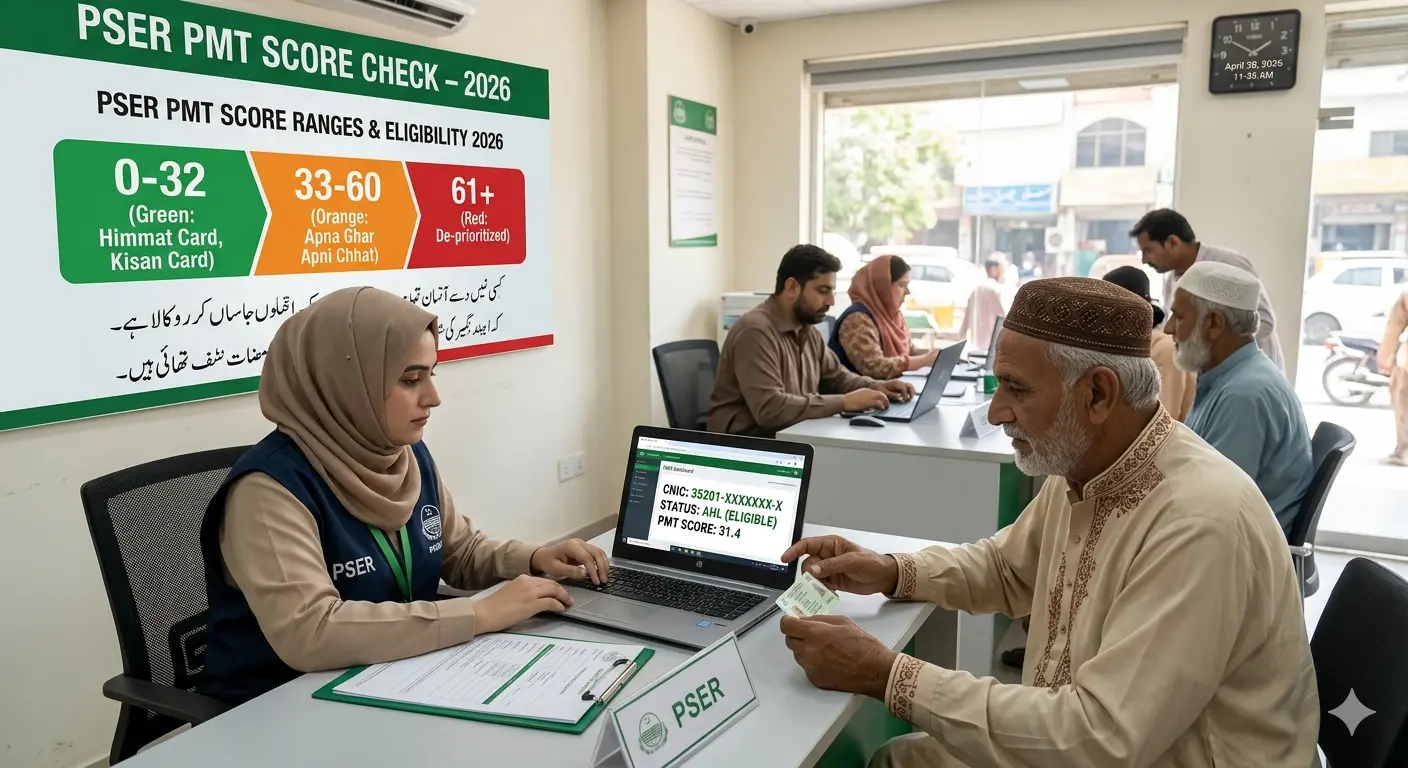
The Proxy Means Test (PMT) score is a number ranging from 0 to 100. This number is a “proxy” for your poverty level.
- A Low Score (e.g., 0-30): Indicates extreme poverty. These households are eligible for almost every cash grant and subsidy.
- A Mid-Range Score (e.g., 31-60): Indicates a “lower-middle-class” status. These households are typically eligible for housing loans and technical training.
- A High Score (61+): Indicates financial stability. These households are generally ineligible for government aid.
3. How to Perform a PSER PMT Score Check in 2026
The Government of Punjab has provided multiple digital gateways to ensure that every citizen can verify their status easily.
Method 1: The Official PSER Web Portal (Recommended)
This is the fastest and most detailed way to check your status.
- Visit the Website: Open your browser and go to pser.punjab.gov.pk.
- Login/Register: If you have already registered at a PSER center, use your CNIC and password to log in.
- Navigate to Dashboard: Once logged in, look for the section labeled “Eligibility Status” or “My PMT Score.”
- View Results: The portal will display your current score and a list of programs (like the Himmat Card) for which you are eligible.
Method 2: The PSER Helpline
For those who prefer a verbal confirmation or do not have a stable internet connection:
- Dial the official Punjab Government helpline (usually 0800-02345 or the specific PSER line provided on their portal).
- Provide your 13-digit CNIC number to the representative.
- Ask specifically for your PSER PMT Score Check result.
Method 3: PSER Registration Centers (Offline)
Every district in Punjab now has dedicated PSER desks, often located within the Deputy Commissioner’s office or local AC offices.
- Visit the desk with your original CNIC.
- The staff will scan your ID and provide a printout of your current registry status.
4. Key Programs Linked to the PSER PMT Score
Knowing your score is only useful if you know what it gets you. Here are the major Punjab-specific programs tied to your PSER data:
| Program Name | Required PMT Score | Benefit |
| Himmat Card | Under 32 | Rs. 10,500 quarterly for PWDs (Persons with Disabilities). |
| Apna Ghar Apni Chhat | Under 60 | Rs. 1.5 million interest-free housing loan. |
| Kisan Card | Under 50 | Subsidies on fertilizers, seeds, and interest-free crop loans. |
| Honahar Scholarship | Varies | Full tuition coverage for high-achieving students from low-income families. |
5. Factors That Influence Your PSER Score
Many citizens are surprised when their PSER PMT Score Check reveals a high number despite their low income. The PSER algorithm looks at “proxies” of wealth, not just your monthly salary.
What Increases Your Score?
- Utility Bills: An average monthly electricity bill exceeding 200–300 units.
- Assets: Ownership of a tractor, car, or more than a certain acreage of land.
- Household Structure: Living in a “Pakka” (brick and mortar) house with multiple rooms.
- Professional Status: If any family member is a government employee or a high taxpayer.
What Lowers Your Score?
- Dependency Ratio: A large number of children or elderly family members supported by a single breadwinner.
- Disability: The presence of a disabled person in the household (this is why the Himmat Card check is so vital).
- Widowhood: Female-headed households often receive a lower (more eligible) score.
6. How to Register for PSER (If You Have No Record)
If you perform a PSER PMT Score Check and the system says “Record Not Found,” it means you are not yet in the Punjab database. You must register to become eligible for provincial schemes.
- Online Registration: Go to the PSER portal and click “New Registration.” Fill out the detailed household survey form.
- Physical Registration: Visit a PSER center with your CNIC, children’s B-Forms, and a recent electricity bill.
- The Wait Period: After registration, it takes 30 to 60 days for the government to verify your data and assign a PMT score.
7. Difference Between PSER and BISP (NSER)
This is a common point of confusion.
- BISP (NSER): A federal database. If you are eligible here, you get the Benazir Kafalat cash (Rs. 10,500–13,500).
- PSER: A Punjab-specific database. Being eligible for BISP doesn’t automatically mean you are registered for PSER, though the two systems often share data. To get Punjab-specific cards (like the Kisan Card), you must ensure your data is in the PSER system specifically.
8. Common Issues & Solutions
“My score is too high (Ineligible).”
If you believe your PSER PMT Score Check is inaccurate (e.g., your score is 45 but you are extremely poor), you can file an appeal. Visit the PSER center and request a “Re-survey.” You will need to provide proof of your actual income and expenses.
“Data Mismatch”
If your name or address on PSER does not match your NADRA CNIC, your score may be suspended. Always update your NADRA record first, then visit the PSER desk to sync the information.
9. PSER PMT Score Check: Safety & Scams
Because these scores are tied to financial aid, scammers often target vulnerable citizens.
- Never pay a fee: The PSER PMT Score Check and the registration process are 100% free.
- Official Links only: Only use websites ending in .gov.pk.
- No Bank Details: The government will never ask for your bank PIN or ATM password during a score check.
Conclusion
The PSER PMT Score Check is the most important digital tool for any resident of Punjab in 2026. Whether you are a farmer looking for a Kisan Card, a student seeking a scholarship, or a family head dreaming of a new home through the “Apna Ghar Apni Chhat” scheme, your PSER score is the key that opens these doors.
Take 10 minutes today to visit the official PSER portal and verify your status. If you aren’t registered, visit your local center immediately.
In the modern era of “Digital Punjab,” staying updated with your registry data is the only way to ensure your family receives the support it deserves.

I am Shan ALI, a Pakistani digital content creator with a strong interest in public welfare, government programs, and making official information accessible to ordinary citizens.