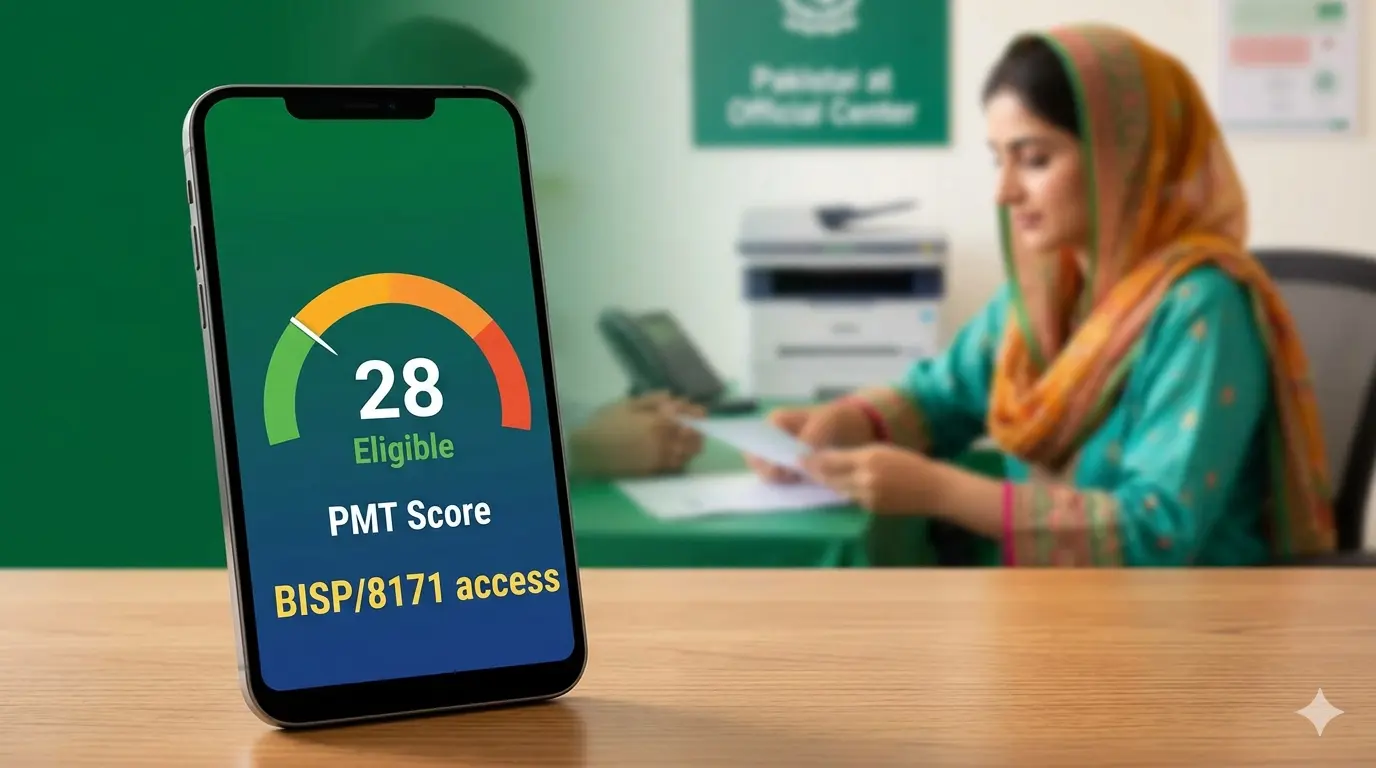
What is the PMT Score is a commonly asked question among people trying to understand eligibility for government support programs in Pakistan. It refers to the Proxy Means Test (PMT) score used mainly in the BISP system to evaluate a household’s financial condition.
This score helps determine whether a family qualifies for financial assistance based on income, assets, and living standards.
1. The Full Meaning of PMT Score
The acronym PMT stands for Proxy Means Test.
What is a “Means Test”?
In wealthy nations, a “Means Test” is simple: the government looks at your bank statements, tax returns, and salary slips. If your income is below a certain line, you get aid.
What is PMT Score (Proxy Means Test)?
In a developing economy like Pakistan, millions of people work in the informal sector. A rickshaw driver, a small-scale farmer, or a domestic worker does not have a formal salary slip. Therefore, the government cannot verify their “means” (income) directly.
Instead, they use “Proxies.” A proxy is a visible sign of a person’s financial status. For example, if a house has a thatched roof and no electricity, these are “proxies” for poverty.
Conversely, owning a tractor or having a high electricity bill are “proxies” for a higher standard of living. The PMT Score is the final numerical value generated by looking at these proxies.
2. The Significance of the PMT Score in Pakistan
The PMT Score is the engine behind the National Socio-Economic Registry (NSER). It is currently used to determine eligibility for:
- BISP Kafalat: Monthly or quarterly cash transfers.
- Taleemi Wazaif: Education stipends for children.
- Nashonuma: Health and nutrition support for pregnant women.
- Himmat Card: Support for Persons with Disabilities (PWDs).
- Utility Store Subsidies: Discounts on flour, sugar, and oil.
- Housing Schemes: Such as “Apni Chhat Apna Ghar.”
3. How the PMT Score is Calculated: The Scientific Formula
The calculation of a PMT score is an automated process, but the variables that go into the formula are extensive. The government uses a Weighted Scoring Algorithm.
The Core Indicators
The NSER survey collects data on approximately 40 to 50 variables. Each variable is assigned a “weight” based on its correlation with poverty.
A. Demographic Characteristics
- Household Size: Larger families generally receive lower scores (indicating higher need), especially if there are many children or elderly members.
- Dependency Ratio: The number of non-working members compared to earners.
- Head of Household: Is the household headed by a woman, a widow, or an orphan? These factors carry significant weight.
B. Housing and Living Conditions
- Structure of the House: Walls made of mud (Katcha) versus brick and cement (Pacca).
- Sanitation: Does the house have a dedicated flush toilet?
- Energy Source: Does the family cook with wood/dung or gas/cylinders?
- Water Access: Is there a motor pump, or do they fetch water from a communal well?
C. Asset Ownership
This is often the most critical part of the calculation. Assets are viewed as “wealth stores.”
- Livestock: The number of buffaloes, cows, or goats owned.
- Land: Ownership of agricultural land (even a few marlas) can drastically change the score.
- Vehicles: Owning a car, a tractor, or even a motorcycle.
- Electronics: Possession of a refrigerator, air conditioner, or washing machine.
D. Economic Proxies
- Utility Bills: Average electricity and gas bills over 6 months are analyzed to gauge consumption patterns.
- Communication: Mobile phone ownership and monthly recharge amounts.
The Mathematical Formula
While the exact weights are kept confidential to prevent fraud, the general structure follows this model:
$$PMT\ Score = (V_1 \times W_1) + (V_2 \times W_2) + (V_3 \times W_3) … + C$$
Where:
- $V$ = Value of the indicator (e.g., 1 for owning a fridge, 0 for not).
- $W$ = Weighted coefficient assigned by the World Bank/BISP economists.
- $C$ = Constant value for normalization.
The result is a score between 0 and 100.
4. How the PMT Score is Assigned: The Step-by-Step Process
Assigning a PMT score is a multi-year effort that involves thousands of field workers and advanced data processing.
Step 1: Data Collection (The NSER Survey)
The process begins with the National Socio-Economic Registry (NSER) survey. There are two ways this data is collected:
- Door-to-Door Survey: Government teams visit every household in a specific district with digital tablets.
- Dynamic Registry (Self-Registration): Citizens visit a BISP Tehsil Center to provide their information.
Step 2: Data Verification & Cleaning
The collected data is synced with the NADRA (National Database and Registration Authority) database.
- The CNICs are verified.
- Household “families” are linked based on NADRA’s family tree data.
- Any duplicate entries are removed.
Step 3: Algorithmic Scoring
The “cleaned” data is passed through the PMT algorithm. The software automatically generates a score. No human—neither the survey officer nor the BISP director—can manually “type in” a score for you. This is designed to prevent corruption and favoritism.
Step 4: Quality Assurance (Spot Checks)
Third-party auditors perform spot checks on roughly 5–10% of the households to ensure the survey teams didn’t record false information. If a house was recorded as “mud” but is actually a “mansion,” the score is revoked.
5. PMT Score Thresholds and Eligibility
Once a score is assigned, it determines which “Tier” of support a family falls into. These thresholds (cut-off points) are adjusted periodically based on the country’s economic inflation.
| Program | PMT Score Limit (Approx.) | Status |
| BISP Kafalat | 0 – 32 | Highly Eligible (Cash Transfers) |
| Himmat Card | 0 – 45 | Eligible for Disability Support |
| Rashan Riayat | 0 – 40 | Eligible for Grocery Subsidies |
| Housing Loans | 32 – 60 | Eligible for Low-Income Housing |
| Ineligible | Above 60 | Considered Self-Sufficient |
6. Common Issues and How to Update Your Score
Many people visit pmtscorecheck.info because they feel their score is incorrect. There are three main reasons a score might not reflect reality:
A. The “Aging” of Data
If your last survey was in 2019, your PMT score is based on your life in 2019. If you lost your job or sold your assets in 2024, the system doesn’t know that yet.
B. Proxy Errors
Sometimes, a family might share a house with a wealthy relative. The electricity meter might be in the name of the head of the household, making their bill look very high, even though multiple families are paying for it.
C. How to Update (The Dynamic Registry)
If you believe your score is too high, follow these steps:
- Visit your local BISP Tehsil Office.
- Ask for the Dynamic Registry Desk.
- Provide your updated electricity bill, CNIC, and B-Forms for your children.
- A new survey will be conducted, and a new PMT score will be assigned within a few weeks.
7. The Future of PMT Scoring (2026 and Beyond)
As we move into 2026, the government is integrating Big Data into the PMT assignment process. This includes:
- Real-time Utility Tracking: Automatically adjusting scores based on massive spikes in electricity usage.
- Travel Records: Using NADRA data to see if a family member has traveled abroad (which usually increases the score and disqualifies the household).
- Vehicle Registration: Linking excise and taxation data to CNICs to ensure car owners are not taking the share of the poor.
Conclusion
The PMT Score is a vital bridge between the government and the citizen. While the mathematics behind it may be complex, its purpose is simple: to create a fair, transparent, and data-driven way to fight poverty.
By understanding the Full Meaning (Proxy Means Test), recognizing the Calculations (the weighted indicators), and knowing how the score is Assigned (NSER and NADRA verification), citizens can better advocate for themselves and ensure they receive the support they deserve.
For those checking their status today, remember that the PMT score is a reflection of your recorded data. Keep your NSER registration updated, and always verify your status through official portals like 8171 or trusted informational guides like pmtscorecheck.info.

I am Shan ALI, a Pakistani digital content creator with a strong interest in public welfare, government programs, and making official information accessible to ordinary citizens.